World
USS Theodore Roosevelt Arrives in Middle East as U.S. Deploys Third Carrier Amid Iran Tensions
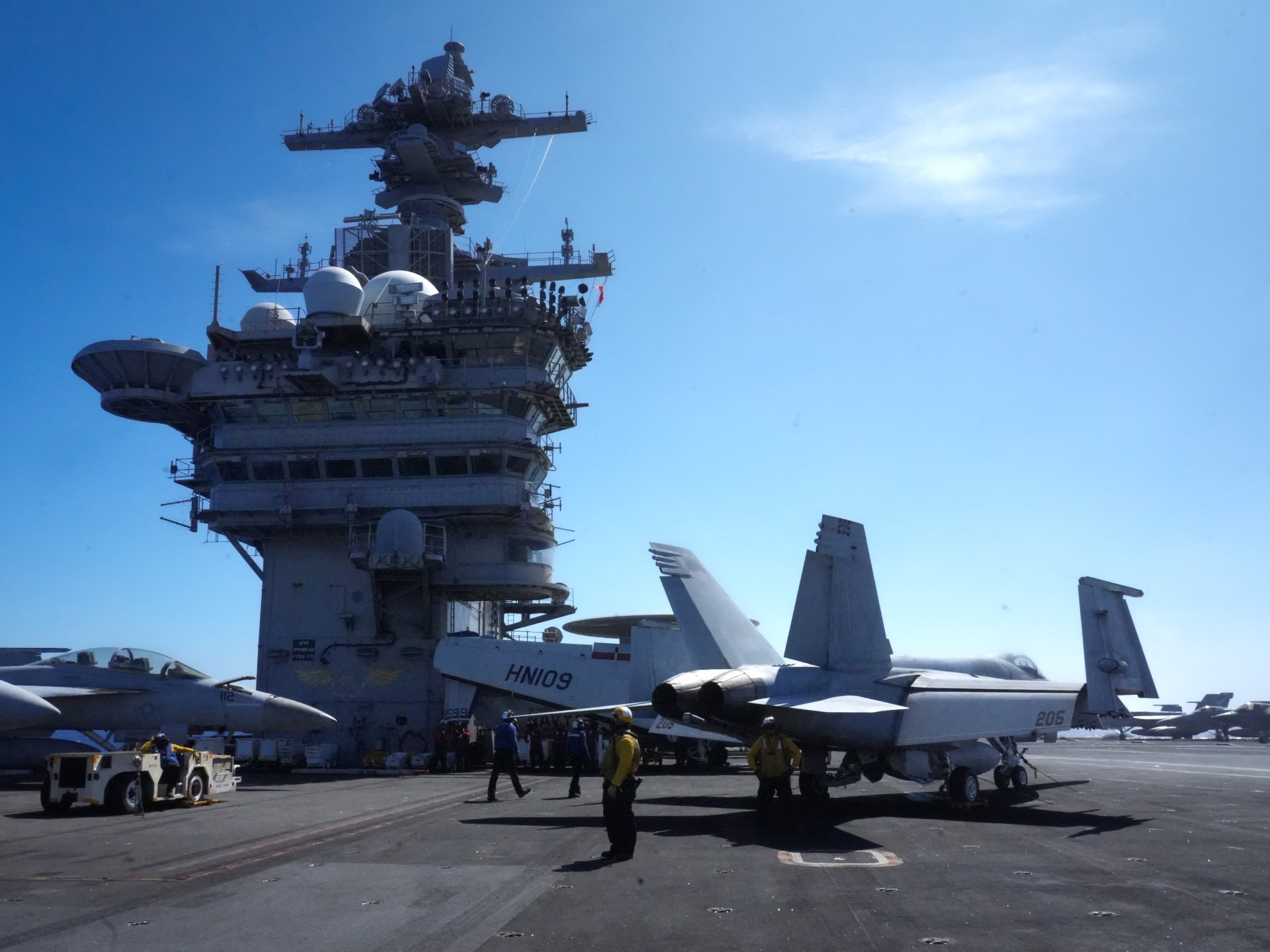
The USS Theodore Roosevelt, a nuclear‑powered aircraft carrier named after President Theodore Roosevelt, has reached the Middle East, joining the USS George Washington and USS George H.W. Bush in the U.S. Central Command area of responsibility. The carrier, commissioned in 1986, carries over 5,000 personnel and a full air wing of more than 60 aircraft, including F‑18s. It has performed combat and humanitarian missions since its commissioning, including operations in the 1990‑91 Gulf War, the 2003 Iraq War, and recent exercises in the Asia‑Pacific region.
According to a U.S. official who spoke to Al Jazeera, the ship left its San Diego base in September and arrived in the Middle East on November 15. The Pentagon and CENTCOM have not formally confirmed the arrival.
The deployment brings the total number of U.S. aircraft carrier strike groups in the region to three. The USS George Washington and USS George H.W. Bush are already operating there. A U.S. official also reported that the Makin Island Amphibious Ready Group, carrying more than 2,000 Marines, has followed the Theodore Roosevelt.
The U.S. has maintained a long‑standing military presence in the Middle East, with eight permanent bases in Bahrain, Egypt, Iraq, Jordan, Kuwait, Qatar, Saudi Arabia and the United Arab Emirates. As of mid‑2025, 40,000 to 50,000 U.S. soldiers were stationed in and around the region.
Since early February, the U.S. has deployed more than 120 aircraft to the region, including E‑3 AWACS, F‑35s, F‑22s, F‑15s and F‑16s, marking the largest surge in U.S. airpower in the Middle East since the Iraq War.
Iran’s deputy foreign minister, Kazem Gharibabadi, warned that Iran would not wait for a U.S. attack and that U.S. forces had not succeeded in blocking Iran. Iran’s foreign minister, Abbas Araghchi, called for stronger regional energy cooperation, citing U.S. and Israeli aggression as a threat to Middle Eastern energy security.
U.S. officials have given mixed signals about the conflict. Secretary of State Marco Rubio said Washington’s economic pressure on Iran was effective, while President Donald Trump stated that further military strikes were “quite unlikely” and that the war was “effectively over” militarily, though he maintained that the U.S. remained prepared if conditions changed.
Diplomatic efforts to end the conflict and reopen the Strait of Hormuz remain stalled. Iran’s parliamentary speaker, Mohammad Bagher Ghalibaf, outlined seven conditions for a deal, including lifting the U.S. naval blockade and sanctions, releasing frozen funds, ending hostilities on all fronts and formally declaring the war over. The U.S. has tightened sanctions and maintained the blockade on Iranian ports.
Analysts note that both sides are in a precarious position, with each believing it holds more leverage. The region’s leaders are seeking a diplomatic resolution, but mistrust and divergent demands continue to complicate negotiations.
Frequently asked questions
When did the USS Theodore Roosevelt arrive in the Middle East?
It arrived on November 15.
How many U.S. aircraft carrier strike groups are in the region?
Three.
How many Marines are aboard the Makin Island Amphibious Ready Group?
More than 2,000 Marines.